
Executive summary
What to know before choosing an integration.
- ✓Celigo is an integration platform, not your storefront or ERP.
- ✓An Integration App, a template, and a custom flow have different scope and ownership.
- ✓Business rules, data quality, and support responsibilities still need an implementation plan.
- ✓Choose against real orders and exceptions, not a connector logo alone.
What does Celigo do?
Celigo is an integration platform as a service, often shortened to iPaaS. It helps businesses move data between applications and automate work that would otherwise involve spreadsheets, manual entry, or separate scripts. Its integration environment is known as integrator.io.
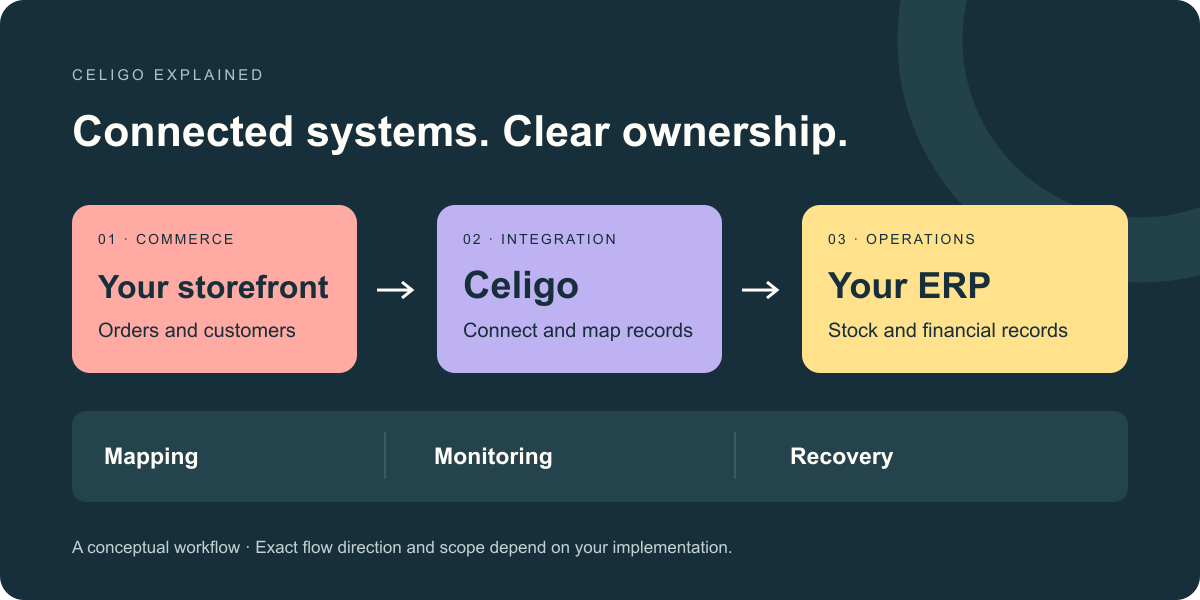
For a commerce team, the useful question is simple: can an order move from the store to the ERP, reach the warehouse, and return shipping information to the customer without someone copying it between systems? Celigo can provide the connections and flow logic within that process. Each application still performs its own business function.
How an integration flow works
Think of a flow as a defined route for a business record. It reads information from a source, applies rules, and sends a result to a destination. A connection provides access to an application; a mapping tells the flow how source fields relate to destination fields.
Consider a new Shopify order. Before it becomes a NetSuite transaction, the implementation needs decisions about customer matching, item identity, payment status, and the transaction type. After import, staff need a way to see whether the record arrived and what to do if it failed. This is where technical configuration meets daily operations.
- Source: which records are eligible, and when should the flow read them?
- Mapping: which fields and reference records does the destination require?
- Destination: should the flow create a record, update one, or leave it unchanged?
- Recovery: who investigates exceptions and confirms the result after a retry?
Integration Apps, templates, and custom flows
These terms are related, but they do not describe the same delivery model. Ask which product is being proposed, what can be configured, and who maintains it. A requirement outside a packaged app's supported scope is not automatically included because the underlying platform can connect the two systems.
| Approach | Starting point | Question to resolve |
|---|---|---|
| Integration App | Packaged flows for a defined application pairing | Does the licensed edition cover our exact workflow? |
| Integration template | A starting set of flows to configure and extend | Who owns changes, testing, and ongoing maintenance? |
| Custom flow | A separately designed integration for a specific need | What platform entitlement, build effort, and support does it require? |
What Celigo connects for Shopify and NetSuite
Celigo offers a Shopify–NetSuite Integration App covering common commerce records, including customers, orders, products, inventory, fulfillment, billing, cancellations, and refunds. Treat this as a family of flows to assess, rather than a promise that every record changes in both directions.
Start with a representative order. Decide which system controls the item and stock quantity, how the payment becomes an accounting record, and where shipping begins. Then test an exception such as a partial shipment or a refund. B2B, POS, returns, and payout requirements deserve explicit scope checks against the proposed product and edition.
For ownership decisions and launch sequencing, read our Shopify–NetSuite integration architecture guide.
When is Celigo a good fit?
Put Celigo on your shortlist when several applications need coordinated flows and your team needs an operating process for those connections. Evaluate a simpler connector as well if the business only needs a narrow, standard workflow. Neither approach should be chosen without checking the records and exceptions you actually use.
An integration platform does not correct inconsistent item identifiers, choose your accounting policy, or decide who owns a customer address. It also does not make every sync instantaneous. Record eligibility, schedules, application limits, and errors all affect when a change reaches the other system.
- Bring examples from each store, currency, location, and order type that matters.
- Identify data cleanup and application changes separately from connector configuration.
- Ask how the solution handles edits, duplicates, retries, and partial failures.
- Budget separately for software, implementation, and ongoing operations.
What an implementation partner should deliver
A useful implementation leaves your team with more than enabled flows. Ask for a documented scope, field ownership, test results, release steps, and a support handover. Someone should be responsible for checking failed records and reconciling the business result, even after the initial launch.
DevTeamPro is a Celigo Standard Partner with three Builder Core certified team members. We work across the storefront, Celigo, and NetSuite so that an issue can be traced through the connected systems. Our Antique Candle project is one example of work spanning Shopify, NetSuite, Celigo, orders, inventory, and wholesale invoicing.
See the project context in our Antique Candle Co. case study.
Technical questions
Useful answers before implementation.
Is Celigo the same as integrator.io?+
Celigo is the company and platform brand. integrator.io is the integration environment used to connect applications and operate flows. When reviewing a proposal, confirm the specific platform subscription, Integration App, template, and add-ons involved.
Is Celigo an ERP system?+
No. Celigo connects applications such as an ERP, a storefront, or a CRM. NetSuite continues to hold and process the ERP records; Celigo provides integration flows between it and other systems.
Does Celigo require coding?+
Standard flows may be configured through the platform's tools. Some requirements need expressions, scripts, application changes, or separately scoped custom flows. Assess your business rules before assuming either a fully no-code project or a custom development project.
How much does a Celigo implementation cost?+
There is no single price for every implementation. Scope depends on the applications, stores, record types, data quality, exceptions, and testing needed. Ask for current software licensing and a separate implementation estimate, with ongoing support scoped explicitly.
Official references